
Blog Feed
- Valley of the Gods (Shenxiangu) 神仙谷

Shenxiangu (aka Valley of the Gods or Fairy Valley) in Donghe Township of Miaoli County is an amazing scenic area with multiple waterfalls flowing into a small mountain valley. The trail is short and includes a suspension bridge over the waterfalls, offering beautiful views of the area. It is a worthwhile stop for anyone visiting the area.
🏯 Planning your trip to Miaoli? ☀️
Here are some top travel tips for you:
- Best time to visit: Summer when it is warm and less windy
- Book tickets to Shokolake for a discount on Klook here
- How to get there: Taiwan High-Speed Railway and Inter-City Bus Book a room at Shokolake on Agoda here
- Book tours and activities in Miaoli on Klook
- Stay connected with a local SIM
- Rent a car to explore distant sights
Historical Background:
Shenxian Valley, located about two kilometers before Luchang at the confluence of the Fengmei and Biling streams, is the most distinctive scenic spot in the area. Formerly known as Death Valley and once used as a burial ground by the Atayal people’s ancestors, it was renamed Shenxian Valley in 1983 after a visit by the Miaoli County magistrate. The landscape is broad and divided into upper and lower sections: the upper rock bed is sculpted by rushing water into beautiful natural patterns, while about 30 meters below, the lower section features six to seven stepped rock tiers where water cascades into multiple waterfalls and forms a clear, cool pool. Because the streambed is steep and potentially dangerous, well-designed trails have been built to allow visitors to safely enjoy forest walks, fresh phytoncide-rich air, flowing water, and mountain breezes, as well as the valley’s mysterious beauty. A 150-meter Atayal-style suspension bridge connects to the Shimen Trail on the opposite bank, offering contrasting views of dramatic rock formations upstream and a deep, emerald gorge downstream.
Hours:
24/7
Price:
Free
Cherry Blossom Season:
Cherry Blossoms can be seen here from February to late March. Check out our full guide to Cherry Blossom Season in Taiwan here.
Firefly Season:
Firefly season is from May to June. Check out our firefly season guide here.
Where to stay:
We have stayed at and recommend Beautiful Landscape Resort, a fish farm and resort near Nanzhuang Old Street (you can book on Agoda here or Booking.com here), and Yuan Motel, a high-class car motel which includes a great breakfast buffet (you can book on Agoda here or Booking.com here). We also recommend Flying Cow Ranch which includes cabins and camping right on the tourist ranch; you can book a room on Agoda here, Booking.com here, or Trip.com here.
Looking for a hotel? Find out where to stay in our Taiwan hotels guide or search for the best hotel deals in Taiwan here.Activities in Miaoli:
There are many tours and activities available in Miaoli such as Schokolake Chocolate Factory, Shangshun World, West Lake Resortopia, Suweila Manor, Baba Kengdao, Hobbit Valley, Zhuo Ye Cottage Duck Box and more on Klook here or KKday here.
How to get there:
By Car/Scooter: From Zhunan, take Provincial Highway 3 to Sanwan, and then switch to County Highway 124 until you reach Nanzhuang. The continue up county highway 21 until you reach the trailhead. There is a free parking lot on the side of the road.
Looking for scooter rental in Miaoli? You can search on Klook here or KKday here to search for options. You can also check out our scooter rental guide here.
If you are looking for car rentals, you can also search Qeeq here, Klook here, or KKday here. You can also check out our car rental guide here.
By TRB/Bus: Unfortunatley, there is no public transportation nearby.
By Bicycle:
Cycling is the best way to enjoy Taiwan’s landscapes if you have the time and energy. Looking for bicycle rentals in Taiwan? You can use Taiwan’s many Youbike sharing stations, or search for rentals on KKday here, and search for tours on Klook here. You can also check out our Taiwan cycling guide here. You can also book a Sunset Riverside Bike Ride and Historical Tour, 4 Hour Cycling in Taipei, Ultimate 8-Hour Cycling City Tour, or Taipei City Bike Tour with Night Market Experience on TripAdvisor here.
For more information, check out our Taiwan transportation guide here.Map:
Please see below:
Drone Footage:
You can check out our drone footage of Shen Xian Gu above or the 360 panorama below. Two converging waterfalls at Valley of the Gods waterfall (Shenxian Valley), shown in 360 degree spherical panorama for…
Posted by Foreigners in Taiwan 外國人在台灣 on Wednesday, January 20, 2021Our Journey:
We have been to Shenxiangu once during our visit to Nanzhuang Old Street. The scenery here was heavenly. It is for sure one of the most beautiful scenes in Taiwan. It is a short hike and will not take too much time to hike down, so it is definitely worth visiting.

On the way from Nanzhuang, there was beautiful scenery along the way. I highly recommend visiting this stretch or road.

Further up, you can also hike Jialishan, a prominent peak in the area, which is also becoming a very popular hike.

What appears to be part of an old, washed-out roadway.

Another view of a nearby cliff face.

Another view of some nearby cliffs.

Bathrooms in front of the trailhead to Shenxiangu.

A hostel near the trailhead.

Outdoor eatery near the trailhead.

Here it says the walk down takes only five minutes.

Here there are some narrow cement steps down the hill.

Some chickens and bamboo nearby.

The last few steps down to the waterfall.

Warning, for your own safety, do not take place in water activities such as river-tracing here.

Now we reach the flat, wooden boardwalk that goes to the waterfall.

First view of the suspension bridge.

End of the suspension bridge here.

Shenxiangu Suspension Bridge.

Horizontal view of the suspension bridge here.

First view of Shenxiangu Waterfall from the suspension bridge.

Wide view of the waterfall area.

View downriver.

Another view looking down at the riverbed.

Horizontal view of the riverbed.

Verticle view of the waterfall area.

View from the end of the suspension bridge.

View looking down the suspension bridge.

Banana trees at the end of the trail. The trail sadly ends here, but may have continued onward previously.

Closeup on the waterfall.

View of the right side of the waterfall.

View of the left side of the waterfall.

Aerial view of the waterfall.

View from inside the valley via drone.

Overview of the waterfall via drone.

One last view via drone.

Hike back up the hill.

More beautiful views near the waterfall.
Check out our full travel guide to Miaoli here.
You can also check out our full travel guide to Taiwan here.

Sanwan Old Street is a historic area of the small town of Sanwan in rural Miaoli County. Here you can find historical buildings, rural scenery, and wildlife. You can also discover more about Hakka culture in the most Hakka town per capita in Taiwan.
🏯 Planning your trip to Miaoli? ☀️
Here are some top travel tips for you:
- Best time to visit: Summer when it is warm and less windy
- Book tickets to Shokolake for a discount on Klook here
- How to get there: Taiwan High-Speed Railway and Inter-City Bus Book a room at Shokolake on Agoda here
- Book tours and activities in Miaoli on Klook
- Stay connected with a local SIM
- Rent a car to explore distant sights
Historical Background:
Sanwan Township (三灣鄉) gets its name from the Zhonggang River (中港溪), which makes three large bends—Neiwan (內灣), Erwan (二灣), and Sanwan (三灣)—as it flows through the area, depositing rich alluvial plains. These plains became the first places where early settlers cleared land and established villages. Each river bend provided open fields suitable for settlement and farming, and because this area lay at the third bend, it was named Sanwan, meaning “the third bend.”
During the late Ming dynasty, Han Chinese migrants crossed the sea to Taiwan, first settling in Zhukei (竹塹, modern Hsinchu). By the Qing dynasty under the Qianlong Emperor, settlers moved to Zhonggang (中港, today’s Zhunan) and then traveled upstream along the Zhonggang River through Toufen and Neiwan before reaching present-day Sanwan, and later expanding toward Tianwei and Nanzhuang. Most residents of Sanwan are Hakka (客家人), with ancestral roots mainly in Meixian (梅縣) and Jiaoling (蕉嶺) in Guangdong, as well as Haifeng, Lufeng, Raoping, Wuhua, parts of Fujian’s Tingzhou (汀州), and Jiangxi. Traditionally, the people are known for their diligence, frugality, strong sense of community, and adherence to Hakka customs. Farming has long been the main occupation, though in recent years some residents have shifted to commerce or moved to cities, leading to a shortage of agricultural labor.
A notable local landmark is Yonghe Mountain Reservoir (永和山水庫), located on the border of Toufen and Sanwan. It is a typical off-stream reservoir (離槽水庫) that draws water from the upper Zhonggang River via an 11-kilometer diversion canal, reducing sediment buildup and helping maintain clean water quality. Surrounded by dense forests, the reservoir area is ecologically rich, home to over 130 bird species and many other plants and animals. Each winter, 600 to 1,000 cormorants (鸕鶿) migrate here, making it an especially valuable site for birdwatching, with interpretive signs installed by the Miaoli County Wild Bird Society for self-guided ecological tours.
Sanwan Township is located at the northern end of Miaoli County, Taiwan, covering about 52 square kilometers along the middle reaches of the Zhonggang River. It is a hilly, agricultural area bordered by Toufen City, Zaoqiao, Shitan, Nanzhuang, and Emei Township in Hsinchu County, with a rainy season from May to September. The township is notable for having the highest proportion of Hakka residents in Taiwan, with Hakka people making up about 99% of its population. The name “Sanwan” (meaning “three bends”) comes from three large bends of the Zhonggang River that created fertile plains where early settlers established villages. As of late 2025, Sanwan has around 5,700 residents in about 2,300 households, with most engaged in agriculture. The township consists of eight villages, has a gradually declining population, and is served by provincial and county highways, bus routes, and local roads, with nearby attractions including Yonghe Mountain Reservoir, forest trails, temples, and well-known agricultural products such as pears, rice, strawberries, and free-range chicken.
Hours:
24/7
Price:
Free
Cherry Blossom Season:
Cherry Blossoms can be seen here from February to late March. Check out our full guide to Cherry Blossom Season in Taiwan here.
Firefly Season:
Firefly season is from May to June. Check out our firefly season guide here.
Where to stay:
We have stayed at and recommend Beautiful Landscape Resort, a fish farm and resort near Nanzhuang Old Street (you can book on Agoda here or Booking.com here), and Yuan Motel, a high-class car motel which includes a great breakfast buffet (you can book on Agoda here or Booking.com here). We also recommend Flying Cow Ranch which includes cabins and camping right on the tourist ranch; you can book a room on Agoda here, Booking.com here, or Trip.com here.
Looking for a hotel? Find out where to stay in our Taiwan hotels guide or search for the best hotel deals in Taiwan here.
Activities in Miaoli:
There are many tours and activities available in Miaoli such as Schokolake Chocolate Factory, Shangshun World, West Lake Resortopia, Suweila Manor, Baba Kengdao, Hobbit Valley, Zhuo Ye Cottage Duck Box and more on Klook here or KKday here.
How to get there:
By Car/Scooter: From Zhunan, take Provincial Highway 3 to Sanwan.
Looking for scooter rental in Miaoli? You can search on Klook here or KKday here to search for options. You can also check out our scooter rental guide here.
If you are looking for car rentals, you can also search Qeeq here, Klook here, or KKday here. You can also check out our car rental guide here.
By TRB/Bus: From Zhunan station, take bus 5806 to Sanwan Station. The whole trip should take less than an hour, one way. You can also book a TRB travel pass on Klook here.
By Bicycle:
Cycling is the best way to enjoy Taiwan’s landscapes if you have the time and energy. Looking for bicycle rentals in Taiwan? You can use Taiwan’s many Youbike sharing stations, or search for rentals on KKday here, and search for tours on Klook here. You can also check out our Taiwan cycling guide here. You can also book a Sunset Riverside Bike Ride and Historical Tour, 4 Hour Cycling in Taipei, Ultimate 8-Hour Cycling City Tour, or Taipei City Bike Tour with Night Market Experience on TripAdvisor here.
For more information, check out our Taiwan transportation guide here.
Map:
Please see below:
Our Journey:
We have been to Sanwan Old Street only once on our way to Nanzhuang. It looks like many other small towns in Taiwan, but it is a little different because it sits upon hilly terrain, and you can see great views of the surrounding valley. There are not many shops or tourists here, but if you love history, then this may be a place worth exploring.
The sign to the old street sits on the side of the road here, next to a pavilion.

The pavilion here overlooks a valley that is filled with farm land. If this valley were in Taipei, it would almost certainly be covered in concrete and high-rises.

Coming from Taipei, this is a nice break from the hustle and bustle of the city.

Map of Sanwan Village. Here you can see that the old street main road, officially Zhongshan Road, is also known as Miaokou Old Street (literally street in front of the temple).
Sanwan Wugu Temple 三灣五穀廟

Wugu (五穀) literally means “the Five Grains.” In traditional Chinese culture, it refers to the staple crops that sustained early agrarian society and symbolized food security, prosperity, and survival.
The exact list of the five grains varies by time and region, but it commonly includes:
Rice (稻)
Millet (黍 or 稷)
Wheat (麥)
Beans (豆)
Sorghum or another millet-type grain (often 粟)
The Wugu Temple (五穀廟) in Sanwan is dedicated to Shennong, the Yan Emperor (炎帝神農氏), the agricultural deity who was central to belief in Taiwan’s early farming society, as settlers who reclaimed land along the Zhonggang River prayed to him for good weather and abundant harvests. Because traveling on foot to worship at the Wugu Temple in Zhunan was difficult, locals petitioned for a spiritual branch of Shennong to be established in Sanwan, leading to the temple’s founding in 1852 during the Qing dynasty; it was destroyed in the 1935 Hsinchu earthquake, rebuilt after the war, and reconstructed into its present two-story form in 1980. The first floor, Chongxian Hall (崇仙宮), enshrines Zhen Nai Xianweng (真乃仙翁), while the second floor honors Shennong the Great Emperor (神農大帝) alongside deities such as the Three Officials (三官大帝), Guanyin (觀世音菩薩), Mazu (天上聖母), Wenchang (文昌帝君), and others; the temple also preserves historically significant longevity tablets (長生祿位) for Qing-era figures Li Shenyi (李慎彝) and Xiang Renyi (向仁鎰) in recognition of their contributions to early settlement. Renowned for its ornate carvings and historic plaques, including the 1894 inscription “You Wo Wu Jiang” (佑我無疆), the temple remains a focal point of local faith and culture, with a major celebration held each year on the 26th day of the fourth lunar month to mark Shennong’s birthday, making it an important site for understanding Sanwan’s agricultural history and human heritage.

Sign to a local restaurant called “A mao sao’s place.”

The street is made of bricks here, which tells you that its the old street.


Old people resting near the river valley.

Here you can see a communal area with some sun covering. Maybe they have annual events here.

Sign pointing to nearby temples and a park. With someone hanging their clothes here.

Public toilet along the old street.

Another view down the old street.

At the end of the old street, you can see a wet market area which was closed when we visited.

View of the street in front of the vegetable market.

View of the main Sanwan’s Main Street, Zhongzheng Road, which has many more food options, and many places where you can find authentic Hakka cuisine.
Shitoushan (Lion Head Mountain) 獅頭山

Nearby, you can also check out Shitoushan in Miaoli, which is a popular hiking destination near Nanzhuang Old Street, one of Taiwan’s lesser 100 peaks, and has one of the highest concentrations of temples for any hiking trail in Taiwan. Here you can get away from it all and be swept up in the rugged beauty of Taiwan’s central foothills. It is definitely a worthwhile adventure for any traveler…(read more)
Nanzhuang Old Street 南庒老街

You can also check out Nanzhuang Old Street, which is a large tourist street and shopping area in central Miaoli. It is actually three old streets combined into one, and includes a night market too. You can find all kinds of food options here, and authentic Hakka dishes. Nearby, you can also find amazing hiking trails and mountain scenery to enjoy…(read more)
Check out our full travel guide to Miaoli here.
You can also check out our full travel guide to Taiwan here.

Shitoushan in Miaoli is a popular hiking destination near Nanzhuang Old Street, one of Taiwan’s lesser 100 peaks, and has one of the highest concentrations of temples for any hiking trail in Taiwan. Here you can get away from it all and be swept up in the rugged beauty of Taiwan’s central foothills. It is definitely a worthwhile adventure for any traveler.
🏯 Planning your trip to Miaoli? ☀️
Here are some top travel tips for you:
- Best time to visit: Summer when it is warm and less windy
- Book tickets to Shokolake for a discount on Klook here
- How to get there: Taiwan High-Speed Railway and Inter-City Bus Book a room at Shokolake on Agoda here
- Book tours and activities in Miaoli on Klook
- Stay connected with a local SIM
- Rent a car to explore distant sights
Historical Background:
Lion’s Head Mountain (Shitoushan) is located at the junction of Nanzhuang and Sanwan townships in Miaoli County and Emei Township in Hsinchu County. Rising to 491 meters above sea level, it is one of Taiwan’s “Small 100 Peaks.” The mountain sits on the watershed between the Zhonggang River and its tributary, the Emei River, and is marked by a third-class triangulation point. The summit hosts meteorological monitoring and communications relay facilities and offers clear westward views toward the Sanwan area.
Shitoushan is one of northern Taiwan’s most important Buddhist and Taoist sacred mountains. As early as 1895, Buddhist monks used the natural rock caves to establish temples, beginning with Shiyan Cave (Yuanguang Temple). Over time, numerous temples were built across the front mountain (the “lion’s head”) and the rear mountain (the “lion’s tail”), connected by what is now known as the Lion Mountain Historic Trail. In 1927, the mountain was selected as one of the “Twelve Scenic Spots” among Taiwan’s Eight Scenic Wonders. In 2001, with the establishment of the Tri-Mountain National Scenic Area, Lion’s Head Mountain and its surrounding attractions were officially incorporated into the Shitoushan Scenic Area.
Hours:
11 AM to 7 PM
Price:
300 NT per person.
You can buy tickets for a discount on Klook here or KKday here.
Cherry Blossom Season:
Cherry Blossoms can be seen here from February to late March. Check out our full guide to Cherry Blossom Season in Taiwan here.
Firefly Season:
Firefly season is from May to June. Check out our firefly season guide here.
Where to stay:
You can book a room at Shokolake on Agoda here or Booking.com here.
We have stayed at and recommend Beautiful Landscape Resort, a fish farm and resort near Nanzhuang Old Street (you can book on Agoda here or Booking.com here), and Yuan Motel, a high-class car motel which includes a great breakfast buffet (you can book on Agoda here or Booking.com here). We also recommend Flying Cow Ranch which includes cabins and camping right on the tourist ranch; you can book a room on Agoda here, Booking.com here, or Trip.com here.
Looking for a hotel? Find out where to stay in our Taiwan hotels guide or search for the best hotel deals in Taiwan here.
Activities in Miaoli:
There are many tours and activities available in Miaoli such as Schokolake Chocolate Factory, Shangshun World, West Lake Resortopia, Suweila Manor, Baba Kengdao, Hobbit Valley, Zhuo Ye Cottage Duck Box and more on Klook here or KKday here.
How to get there:
By Car/Scooter: From Zhunan, take Provincial Highway 3 to Sanwan, and then switch to County Highway 124 until you reach Nanzhuang.
Looking for scooter rental in Miaoli? You can search on Klook here or KKday here to search for options. You can also check out our scooter rental guide here.
If you are looking for car rentals, you can also search Qeeq here, Klook here, or KKday here. You can also check out our car rental guide here.
By TRB/Bus: From Zhunan station, take bus 5806 to Nanzhuang. The whole trip should take an hour, one way. You can also book an TRB travel pass on Klook here.
By Bicycle:
Cycling is the best way to enjoy Taiwan’s landscapes if you have the time and energy. Looking for bicycle rentals in Taiwan? You can use Taiwan’s many Youbike sharing stations, or search for rentals on KKday here, and search for tours on Klook here. You can also check out our Taiwan cycling guide here. You can also book a Sunset Riverside Bike Ride and Historical Tour, 4 Hour Cycling in Taipei, Ultimate 8-Hour Cycling City Tour, or Taipei City Bike Tour with Night Market Experience on TripAdvisor here.
For more information, check out our Taiwan transportation guide here.
Map:
Please see below:
Drone Footage:
360 Degree Panorama:
You can also see our panorama of the area below.
360 degree view from Lion Head Mountain (Shitoushan) in Miaoli. This mountain has one of the highest concentrations of temples and hiking trails in Taiwan. #獅頭山 #苗栗 #南庄
Posted by Foreigners in Taiwan 外國人在台灣 on Monday, January 18, 2021
Our Journey:
We have been to Shitoushan twice. I cannot say I have hiked all the trails and seen all the temples here. This sacred mountain is riddled with temples and trails anywhere you can shake a stick. It is a fun spider-web of trails to check out for any avid hiker in Taiwan.

Here you can see the entrance to Shitoushan Scenic Area.

Here are only some of the trails around Shitoushan.

First, we drove over to the Shitoushan Visitor’s Center to get our bearings.

View of a tea shop near the visitor’s center.

Another tourist map of Shitoushan.

More maps of the surrounding area at the visitor’s center.

Another map of Lion Mountain Old Trail.

Then we found ourselves at the Wang Yue Pavilion, which literally means “stare at the moon pavilion.”

Wanguyuan Pavilion
The original Wanguyuan Pavilion was built on the instigation of General Huang, as a rest and shelter for travelers. It was later rebuilt at the boundary between Hsinchu and Miaoli counties.
The pavilion is named after the three characters written by General Huang. From here, visitors can enjoy a fine view of Lion’s Head Mountain. A walk of about 20 minutes along the trail brings you to the Lion’s Head Mountain, at an elevation of 492 meters.
The pavilion offers a place to rest, enjoy the scenery, and refresh the mind and spirit.

Shishan Historic Trail
The Wanguyuan Pavilion is perched at the highest point of the Shishan Historic Trail, which is also where Hsinchu and Miaoli counties meet. The width of the trail is narrow and steep, and the old stone trail was built in 1914 during the Japanese occupation period.
The trail runs from the back of the mountain down to the front, and was expanded into today’s scenic walkway in 1971. It was broadened to approximately 2.5 kilometers, running from the Lianda Archway, Gate of Guanyin Temple, to the Lion’s Tail Arch, and generally takes about two hours to traverse.

There are some stone tables here to rest upon.

There is also a service road that traverses the top of Lion Head Mountain.

View of Nanzhuang from the top of Shitoushan.

View of the central mountain range looking east.

Closeup on Snow Mountain.

Another view of scenery down below.

Stone steps leading down the mountain.

Back to Wang Yue Pavilion.

There are temples wherever you go on this mountain.

Weather tracking equipment on top of the mountian.

Finally made it to the top! 492 meters above sea level.

View from the top of Shitoushan.

View of the weather equipment at the top.

The trail curves around this area.

And also follows along this fenced area.

The trail then enters the forest.

We then came upon this park in front of Tianguang Temple.

Stone monument in front of Tianguang Temple.

Viewing platform.

Gate to Tianguang Temple.

View of the main temple here.

View overlooking Miaoli from Tianguang Temple.

Oranges were in season when we visited.

Aerial view looking down at Nanzhuang.

View looking East at Snow Mountain.
Another view looking north with the face of Lion Head Mountain in the foreground.
For more views and insights into this mountain, check out this blog by Taiwan Trails and Tales.
Nanzhuang Old Street 南庒老街
Nanzhuang Old Street is a large tourist street and shopping area in central Miaoli. It is actually three old streets combined into one, and includes a night market too. You can find all kinds of food options here, and authentic Hakka dishes. Nearby, you can also find amazing hiking trails and mountain scenery to enjoy…(read more)
Sanwan Old Street 三灣老街

Just down the road is Sanwan Old Street, which is a historic area of the small town of Sanwan in rural Miaoli County. Here you can find historical buildings, rural scenery, and wildlife. You can also discover more about Hakka culture in the most Hakka town per capita in Taiwan…(read more)
Thanks for reading, and check out more of our blogs on Miaoli to come!
Check out our full travel guide to Miaoli here.
You can also check out our full travel guide to Taiwan here.
Nanzhuang Old Street is a large tourist street and shopping area in central Miaoli. It is actually three old streets combined into one, and includes a night market too. You can find all kinds of food options here, and authentic Hakka dishes. Nearby, you can also find amazing hiking trails and mountain scenery to enjoy.
🏯 Planning your trip to Miaoli? ☀️
Here are some top travel tips for you:
- Best time to visit: Summer when it is warm and less windy
- Book tickets to Shokolake for a discount on Klook here
- How to get there: Taiwan High-Speed Railway and Inter-City Bus Book a room at Shokolake on Agoda here
- Book tours and activities in Miaoli on Klook
- Stay connected with a local SIM
- Rent a car to explore distant sights
Historical Background:
Nanzhuang Old Street is located in the main settlement of Nanzhuang Township in Miaoli County, Taiwan, and is traditionally Hakka, known for its strong nostalgic atmosphere that draws large crowds on weekends. Centered historically along Zhongzheng Road, the area features many shops and attractions such as Yongchang Temple, the Old Post Office, Osmanthus Alley (桂花巷), and the Washhouse Pit. After severe damage from the 1935 Guandao Mountain earthquake, the street was rebuilt under Japanese planning, resulting in today’s distinctive two-story Japanese-style wooden buildings lining Zhongzheng Road. Over time, Osmanthus Alley—originally named after a small noodle shop—was developed by local authorities and businesses into the well-known “Osmanthus Alley Community,” gradually becoming the most recognized part of Nanzhuang Old Street, which is also famous for Hakka snacks, osmanthus-flavored treats, lei cha, and other traditional foods.
Hours:
Most shops are open from about 10 AM to 6:30 PM
Price:
Free
Cherry Blossom Season:
Cherry Blossoms can be seen here from February to late March. Check out our full guide to Cherry Blossom Season in Taiwan here.
Firefly Season:
Firefly season is from May to June. Check out our firefly season guide here.
Where to stay:
You can book a room at Shokolake on Agoda here or Booking.com here.
We have stayed at and recommend Beautiful Landscape Resort, a fish farm and resort near Nanzhuang Old Street (you can book on Agoda here or Booking.com here), and Yuan Motel, a high-class car motel which includes a great breakfast buffet (you can book on Agoda here or Booking.com here). We also recommend Flying Cow Ranch which includes cabins and camping right on the tourist ranch; you can book a room on Agoda here, Booking.com here, or Trip.com here.
Looking for a hotel? Find out where to stay in our Taiwan hotels guide or search for the best hotel deals in Taiwan here.
Activities in Miaoli:
There are many tours and activities available in Miaoli such as Schokolake Chocolate Factory, Shangshun World, West Lake Resortopia, Suweila Manor, Baba Kengdao, Hobbit Valley, Zhuo Ye Cottage Duck Box and more on Klook here or KKday here.
How to get there:
By Car/Scooter: From Zhunan, take Provincial Highway 3 to Sanwan, and then switch to County Highway 124 until you reach Nanzhuang.
Looking for scooter rental in Miaoli? You can search on Klook here or KKday here to search for options. You can also check out our scooter rental guide here.
If you are looking for car rentals, you can also search Qeeq here, Klook here, or KKday here. You can also check out our car rental guide here.
By TRB/Bus: From Zhunan station, take bus 5806 to Nanzhuang Zhongshan Road Intersection. The whole trip should take an hour, one way. You can also book an TRB travel pass on Klook here.
By Bicycle:
Cycling is the best way to enjoy Taiwan’s landscapes if you have the time and energy. Looking for bicycle rentals in Taiwan? You can use Taiwan’s many Youbike sharing stations, or search for rentals on KKday here, and search for tours on Klook here. You can also check out our Taiwan cycling guide here. You can also book a Sunset Riverside Bike Ride and Historical Tour, 4 Hour Cycling in Taipei, Ultimate 8-Hour Cycling City Tour, or Taipei City Bike Tour with Night Market Experience on TripAdvisor here.
For more information, check out our Taiwan transportation guide here.
Map:
Please see below:
Drone Footage:
360 Degree Panorama:
You can also check out our 360-degree panorama below.
Nanzhuang Old Street, shown in 360 degree spherical panorama for your viewing pleasure. This is definitely a worthwhile…
Posted by Foreigners in Taiwan 外國人在台灣 on Tuesday, January 19, 2021
Our Journey:
We have been to Nanzhuang Old Street twice. I also stayed overnight near there at Beautiful Landscape Resort, a fish farm and resort near Nanzhuang Old Street (you can book on Agoda here or Booking.com here). I was surprised at how big and crowded the old street was, considering how remote it is in Taiwan. It is definitely one of the best old streets in Taiwan and is worth visiting for tourists.

If you visit from the south side, you will notice a big, beautiful suspension bridge that goes across the river here.
Kangji Suspension Bridge 康濟吊橋

Kangji Bridge was originally built in December 1953, spanning the Donghe River with a length of about 58 meters and a width of 4 meters. It was the first reinforced concrete bridge in the area and was named “Kangji Bridge” because of its vital role in transportation and the local economy. The bridge connected key routes linking Nanjhuang, Donghe (Miaoli Route 21), Penglai (County Road 124), and the Nanjiang area. Due to the area’s flood-prone terrain, severe damage occurred during Typhoon Ellen in 1959 and Typhoon Gloria in 1963, leading to the eventual replacement of the route by the Nanjhuang Bridge in 1975.
Following the township’s first urban planning review in 1980, development focused on creating a residential rural town with administrative and commercial functions. As tourism grew from 2001 onward, efforts shifted toward revitalizing Zhongshan Old Street. In December 2009, the Kangji Suspension Bridge was constructed, measuring 154 meters long and 1.5 meters wide, at a cost of NT$27 million. Designed as a scenic suspension bridge with flood control, landscaping, and LED night lighting, it extends the tourist route between Zhongshan and Nanjiang Old Streets, boosting tourism value and supporting sustainable development goals.

Here, the bridge connects with Shisanjian Old Street.

Map of the area.
Nanjiang Old Street 南江老街

Nanjiang Old Street lies on the south side of Kangji Suspension Bridge. You will not find as many touristy spots here, just some quiet old buildings.

View of some of the buildings you might find at Nanjiang Old Street.
Zhongzheng Street 中正路

Shisanjian Old Street has shops and restaurants mainly clustered around the north side of Kangji Suspension Bridge on Zhongshan Road. You will then need to turn onto Zhongzheng Road to get to the main part of Nanzhuang Old Street.

There are more restaurants and eateries clustered around the entrance to Nanzhuang Old Street here.

Here you can find some Japanese-era wooden houses.

Another view of Zhongzheng Street.

Hakka clothing store along Zhongzheng Old Street.

Ginger and sweet potatoes for sale.

Rice, tea, and noodle shops in front of the temple.

Fruit milk and pig blood cake stand.

Hot fish eggs.

Bitter tea stand.

Hakka restaraunt and hat store.

Hakka noodles shop.

Nanzhuang Public Market.
Yongchang Temple 南庄永昌宮

Yongchang Temple was first established in 1905 during the Japanese colonial period. After being destroyed by the Guandao Mountain Earthquake in 1935, the temple was relocated to its current site through the joint efforts of Mr. Zhong Lianfa and seven others, and was completed and consecrated in 1954. About 30 years later, construction was undertaken again in July 1986 to rebuild and expand the temple, with the sacred statues ceremonially enshrined.
The three-story temple, facing west, blends modern and traditional architectural styles. The main hall is dedicated to the Three Palace Emperors, with additional deities including the Jade Emperor, Mazu (the Heavenly Holy Mother), the God of Grains, the Loyal Martyrs Lord, and the Earth God. A plaque reading “Supreme Heavenly Virtue” hangs above the altar, giving the temple a solemn and dignified atmosphere. Inside, the temple preserves important cultural artifacts such as early bronze bells, wooden fish instruments, rice measures over a century old, and historical photographs documenting its construction, making it the central place of worship and community gathering for Nanzhuang Township.

The best part of the old street is near Yongchang Temple.

View from the top of Yongchang temple.

Another view looking up the steps.

Handrail up to the temple.

Main worship area at Yongchang temple.
Nanzhuang Historic Post Office 南庒郵局

The Nanzhuang Post Office, located in Nanzhuang Township, Miaoli County, is one of the county’s ten historic landmarks and was officially designated a historic building on October 23, 2003. Established in 1900 during the Japanese colonial period as the Nanzhuang Post and Telecommunications Office, the original building was destroyed in the 1935 earthquake, and the current structure dates from its subsequent reconstruction. Before its establishment, postal services were handled by the Hsinchu Post Office, but strong local demand—driven by administrative offices, a garrison, and the camphor industry—led to the creation of a postal collection office in 1898, later upgraded to a full post and telegraph office.
After World War II, the post and telecommunications services were jointly managed, then later separated, with the telecommunications office remaining in the building until 1983. The post office itself operated there until 1996, when services moved to a new facility. The former postmaster’s residence behind the building was largely demolished due to severe damage, leaving only its foundation as a reference to traditional Japanese architectural layout. Following its designation as a historic building, the Nanzhuang Post Office underwent restoration, which was completed in 2005.
Chayuanping Trail 茶園坪步道

Chayuanping Trail is located at the top of the Chayuanping Hill behind Nanzhuang Old Street, and it has a total length of 342 meters. Along the trail, you can find a magnificent view of the forest, birds, and insects.
Osmanthus Alley 桂花巷

Osmanthus Alley is so named because Osmanthus Tea is often sold here. In addition, a Taiwanese movie and TV show were filmed here (with the same name), making the area even more famous.

The alley is a pedestrian area with many shops along the way. It is similar to Jiufen in that way.

Here you can find dense alleyways with tons of shops along the way.

When we visited, there were not a lot of tourists visiting, but I think there are lots of visitors on weekends and holidays.

Savory Tangyuan ball soup.

Hakka “Bantiao” flat noodles.

Taiwanese Beef Noodle Soup.

Osmanthus alcohol.

Toy shop along the old street.

More hakka traditional dishes.

Ice cream shot along the alley.
Lots of yelloes along the alley here.

Traditional Tangyuan shop.

More customers arrive.

Peanut candy shop.

Flower shop.

Another Osmanthus alcohol shop.

View of Shitoushan in the background.

Tofu shop along the alley.

We made our way back to Zhongzheng Road.

Downtown Nanzhuang at night.
Shisanjian Old Street 十三間老街

Heading back south, Shisanjian Old Street also has a lot of shops to explore, and some stalls here are open at night.

Restored Japanese era wooden house.
Nanzhuang Mini Night Market 南庒迷你夜市

Nanzhuang Mini Night Market is a small night market that opens on Shisanjian Old Street most nights (there are no opening hours posted online). Think of it as an extension of Nanzhuang Old Street at night.

Stinky tofu, fried squid, fried snail, and corn dogs.

There were also lots of clothes sold here. I bought a fleece jacket here for 100 NT that I still wear to this day.

Octopus ball shop at the end of the street.
Shitoushan (Lion Head Mountain) 獅頭山
Shitoushan in Miaoli is a popular hiking destination near Nanzhuang Old Street, one of Taiwan’s lesser 100 peaks, and has one of the highest concentrations of temples for any hiking trail in Taiwan. Here you can get away from it all and be swept up in the rugged beauty of Taiwan’s central foothills. It is definitely a worthwhile adventure for any traveler…(read more)
Beautiful Landscape Resort 春谷南庄休閒農場

We have stayed at and recommend Beautiful Landscape Resort, a fish farm and resort near Nanzhuang Old Street (you can book on Agoda here or Booking.com here). The rooms here are spacious, and you can also explore the beautiful natural scenery around the resort, as well as the fish farm behind it.

There are lots of fish being farmed here behind the resort.
Shitoushan (Lion Head Mountain) 獅頭山
Nearby, you can also check out Shitoushan in Miaoli, which is a popular hiking destination near Nanzhuang Old Street, one of Taiwan’s lesser 100 peaks, and has one of the highest concentrations of temples for any hiking trail in Taiwan. Here you can get away from it all and be swept up in the rugged beauty of Taiwan’s central foothills. It is definitely a worthwhile adventure for any traveler…(read more)
Sanwan Old Street 三灣老街
Just down the road is Sanwan Old Street, which is a historic area of the small town of Sanwan in rural Miaoli County. Here you can find historical buildings, rural scenery, and wildlife. You can also discover more about Hakka culture in the most Hakka town per capita in Taiwan…(read more)
Thanks for reading, and stay tuned for more blogs on Miaoli to come!
Check out our full travel guide to Miaoli here.
You can also check out our full travel guide to Taiwan here.

Wenshui Old Street is an old trading hub in central Miaoli, close to Dahu, which is known for strawberry farming. On the old street, you can find lots of Hakka traditional cuisine and strawberry-themed snacks. In the meantime, you can enjoy the historical sights and Hakka culture in the area.
🏯 Planning your trip to Miaoli? ☀️
Here are some top travel tips for you:
- Best time to visit: Summer when it is warm and less windy
- Book tickets to Shokolake for a discount on Klook here
- How to get there: Taiwan High-Speed Railway and Inter-City Bus Book a room at Shokolake on Agoda here
- Book tours and activities in Miaoli on Klook
- Stay connected with a local SIM
- Rent a car to explore distant sights
Historical Background:
Dahu Township, located in southern Miaoli County, Taiwan, is a hilly basin known nationwide for its strawberries, earning it the nicknames “Strawberry Kingdom” and “Home of Strawberries.” With a mild, rainy climate and a population that is about 91% Hakka, the township is bordered by Shitan, Gongguan, Tongluo, Sanyi, Zhuolan, and Tai’an. Before Han Chinese settlement, the area was inhabited by Atayal indigenous groups and was known by names meaning “mountain pepper” or referring to a local chieftain or surrounding streams; the modern name “Dahu” (“Big Lake”) dates to 1856, inspired by the basin’s lake-like landscape. Administratively, Dahu has passed through multiple jurisdictions from the Qing dynasty through Japanese rule and postwar Taiwan, becoming part of Miaoli County in 1950. Its terrain is shaped by fault lines and river systems, forming a closed basin drained mainly by the Dahu and Nanhu streams, while its population has steadily declined from over 21,000 in 1981 to about 13,000 in 2024.
Wenshui Old Street is located in Zhumu Village, Shitan Township, Miaoli County, Taiwan, and is predominantly Hakka in character. Historically, it served as a major trading and distribution center for goods from Shitan, Tai’an, and Dahu townships. Situated along Provincial Highway 6 and near Highways 3 and 72, the street blends Hakka culture with local history and arts, and also functions as a gateway for visitors heading to Dahu Township for strawberry picking. After the opening of the east–west Highway 72 expressway, diverted traffic, Wenshui Old Street became a quieter, pedestrian-friendly area, now known for traditional Hakka snacks such as rice cakes and Hakka cuisine.
Hours:
Shops usually open from 8 AM to 5 PM
Price:
Free to visit
Shokolake Chocolate Factory:
300 NT per person.
You can buy tickets at a discount on Klook here or KKday here.
Strawberry Picking Season:
November to March
Cherry Blossom Season:
Cherry Blossoms can be seen here from February to late March. Check out our full guide to Cherry Blossom Season in Taiwan here.
Firefly Season:
Firefly season is from May to June. Check out our firefly season guide here.
Where to stay:
You can book a room at Shokolake on Agoda here or Booking.com here.
We have stayed at and recommend Beautiful Landscape Resort, a fish farm and resort near Nanzhuang Old Street (you can book on Agoda here or Booking.com here), and Yuan Motel, a high-class car motel which includes a great breakfast buffet (you can book on Agoda here or Booking.com here). We also recommend Flying Cow Ranch which includes cabins and camping right on the tourist ranch; you can book a room on Agoda here, Booking.com here, or Trip.com here.
Looking for a hotel? Find out where to stay in our Taiwan hotels guide or search for the best hotel deals in Taiwan here.
Activities in Miaoli:
There are many tours and activities available in Miaoli such as Schokolake Chocolate Factory, Shangshun World, West Lake Resortopia, Suweila Manor, Baba Kengdao, Hobbit Valley, Zhuo Ye Cottage Duck Box and more on Klook here or KKday here.
How to get there:
By Car/Scooter: From Central Miaoli, take Provincial Highway 6 or Expressway 72 east to Dahu. The Old Street is off the first exit in the valley.
Looking for scooter rental in Miaoli? You can search on Klook here or KKday here to search for options. You can also check out our scooter rental guide here.
If you are looking for car rentals, you can also search Qeeq here, Klook here, or KKday here. You can also check out our car rental guide here.
By TRB/Bus: From Miaoli station, take bus 5657 or 5656 to Fayun Temple. The Old Street is about a ten-minute walk from the bus stop. The whole trip should take an hour, one way. You can also book a TRB travel pass on Klook here.
By Bicycle:
Cycling is the best way to enjoy Taiwan’s landscapes if you have the time and energy. Looking for bicycle rentals in Taiwan? You can use Taiwan’s many Youbike sharing stations, or search for rentals on KKday here, and search for tours on Klook here. You can also check out our Taiwan cycling guide here. You can also book a Sunset Riverside Bike Ride and Historical Tour, 4 Hour Cycling in Taipei, Ultimate 8-Hour Cycling City Tour, or Taipei City Bike Tour with Night Market Experience on TripAdvisor here.
For more information, check out our Taiwan transportation guide here.
Map:
Please see below:
Our Journey:
We have been to Wenshui Old Street twice, once when we passed by to pick strawberries in Dahu, and also on another day trip where we took a longer tour. We drove our own car there. We also stayed the night at Shokolake B&B. It was a fun experience, but I recommend not visiting during holidays when there can be heavy traffic.

We first drove from Nanzhuang to Dahu, and along the way found many beaitful places in the hills of Miaoli, such as Donghe Suspension Bridge here.

Another suspension bridge we came across.

Beautiful mountain scenery on the way to Dahu.

First view of Wenshui Old Street. There are lots of traditional Hakka noodle shops along the old street.

You can also usually see lots of tourists and pedestrians here, especially during strawberry season in the winter.

Tangyuan and corn stall.

Strawberry ice cream and ginger for sale.
Wider view of the old street.

Strawberry smoothies for sale.

And here we reached the expressway and the end of the old street, where someone was selling steamed buns.
Dahu, the Kingdom of Strawberries 大湖,草莓王國

Dahu is a large valley in the hills of Miaoli inside Shei-Pa National Park, known for its strawberries, which are in season from November to March, and is also called the Kingdom of Strawberries. Here you can pick your own strawberries for a discount and bring them home. In the meantime, you can enjoy the amazing scenery and Hakka culture in the area…(read more)
Shokolake Country House Chocolate Factory 巧克力雲莊
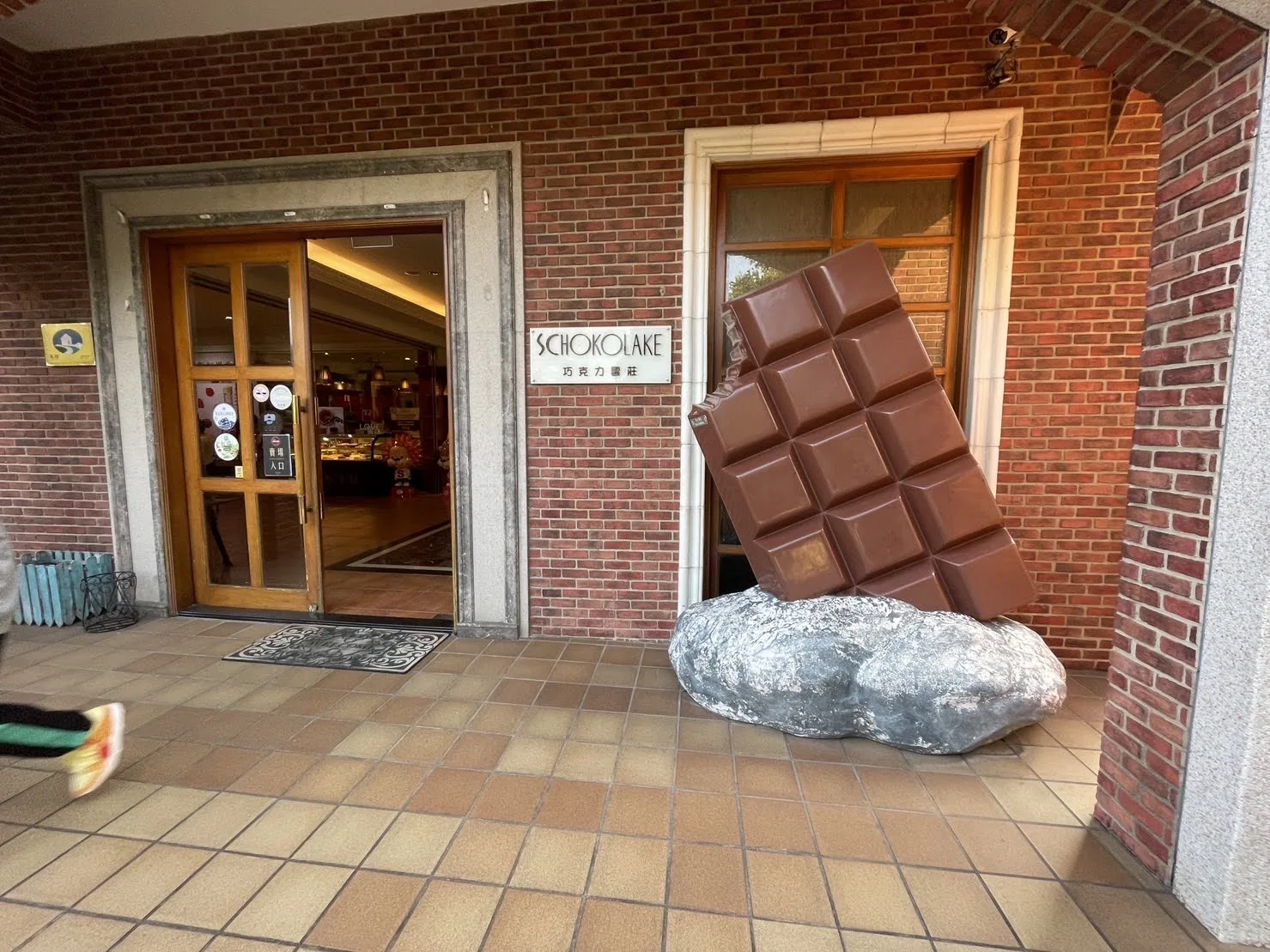
Shokolake Chocolate Factory (aka Shokolate Country House) is a tourist factory, museum, and resort in rural Miaoli, Taiwan. Here you can taste all kinds of chocolate, enjoy gardens, cherry blossoms, and beautiful scenery, try out DIY activities, and more. It is a fun experience for the whole family…(read more)
You can buy tickets at a discount on Klook here or KKday here.
You can book a room at Shokolake on Agoda here or Booking.com here.
Check out our full travel guide to Miaoli here.
You can also check out our full travel guide to Taiwan here.