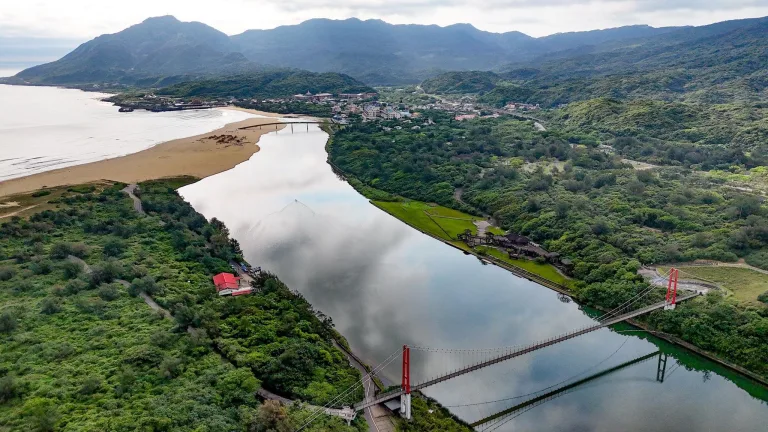
The Jiji Railway Line is a former freight and logging railway built during the Japanese colonial era that has now been converted into a tourist railway. Popular stops along the line include Jiji, Shuili, and Checheng, but there are many hidden gems along the way. It is definitely worth a trip while you are in Taiwan.
🛥️ Planning your trip to Nantou? ⛰️
Here are some top travel tips for you:
- Best time to visit: Winter or Autumn when it is less rainy
- How to get there: Taiwan Railway and Inter-City Bus
- Best place to stay: Kirin Villa or Jenq Yang Hotspring Hotel
- Book tours and activities in Nantou on Klook
- Stay connected with a local SIM
- Rent a car to explore distant sights
Background:
The Jiji Line is a 29.7-kilometer branch railway in central Taiwan operated by the Taiwan Railways Administration (TRA), connecting Ershui in Changhua County with Checheng in Nantou County. It is Taiwan’s longest branch line and the only railway serving Nantou. Originally built by the Taiwan Power Company between 1919 and 1921 to transport materials for the Sun Moon Lake Hydroelectric Project, the line began passenger service in 1922 and was later purchased by the Governor-General of Taiwan in 1927. The Jiji Line became Nantou’s only rail connection after the 1959 floods destroyed nearby sugar railway lines. Though once mainly industrial, it has evolved into a popular tourist route serving small towns such as Mingjian, Jiji, Shuili, and Checheng—areas rich in cultural and natural attractions. The non-electrified line is operated using DR1000-series diesel multiple units and also occasionally carries military cargo trains on a side branch to a logistics base near Longquan.
Severely damaged in the 1999 921 Earthquake, the line was repaired and reopened in 2001, with damaged rails and signs preserved at the Earthquake Memorial Museum. It has since become a symbol of resilience and a beloved sightseeing railway, featured in films such as Remember We Loved. The Jiji Line has also built cultural ties abroad, signing sister-railway agreements with Japan’s Isumi Railway in Chiba (2014) and the Tenryu Hamanako Line in Shizuoka (2016). However, landslides and tunnel collapses between Jiji and Checheng since 2021 have suspended parts of the service, replaced temporarily by shuttle buses. Major reconstruction and tunnel-slope stabilization projects are underway and expected to be completed by December 2025, after which the historic and scenic Jiji Line will fully reopen once again.
Price:
Free
Parking: Around 150 NT per day for cars
Hours:
Shops are open roughly from 9 AM to 6 PM.
Cherry Blossom Season:
Cherry Blossoms can be seen in the park from February to late March. Check out our full guide to Cherry Blossom Season in Taiwan here.
How to get around Nantou:
As always, we recommend renting a scooter as the best way to see Taiwan. However, you can also a great deal of Nantou by taking the train to Taichung and then switching to an inter-city bus, or local bus. Getting around in a car is also a convenient option, as there is plenty of parking pretty much everywhere in this less crowded county.
Scooter Rental: Looking for scooter rental in Nantou? Search Klook here or KKday here to search for options. You can also check out our scooter rental guide here.
Car Rental: If you are looking for car rentals, you can also search Qeeq here, Klook here, KKday here. You can also check out our car rental guide here.
By Bus: You can book tickets to travel to Nantou via inter-city bus on Klook here.
By Train: You can book tickets to Taichung via high speed rail (HSR) on Klook here or KKDay here, or book tickets via the normal train (TRA) on Klook here, then switch to a bus to Nantou.
Bicycle Rental: Cycling is the best way to enjoy Taiwan’s landscapes if you have the time and energy. Looking for bicycle rentals in Taiwan? You can search on KKday here and search for tours on Klook here. You can also check out our Taiwan cycling guide here.
Tours:
There are many tours and activities available in Nantou, such as river Tracing, paragliding, Shanlinxi Forest Recreation Area 杉林溪, Cona’s Chocolate Castle, Shuiyuan Suspension Bridge, JOJOZOO Park, and Aowanda Forest Recreation Area.
You can find more tours of Nantou on Klook here or KKday here.
Where to Stay:
We have stayed at and recommend Jenq Yang Hotspring Hotel (you can book on Agoda here, Booking.com here, Trip.com here, or Klook here), a hot spring hotel near the mystical Lushan hot spring, and Maple Leaf Holiday Villa (you can book on Agoda here, Booking.com here, Trip.com here, or Klook here), a lodge with a great view and within walking distance of Cingjing Farm. I also have stayed at and recommend Kirin Villa (you can book on Agoda here), a mountain resort in Puli near Sun Moon Lake.
Looking for a hotel? Find out where to stay in our Taiwan hotels guide or search for the best hotel deals in Taiwan here. We recommend booking through Agoda here, which provides the best quality accommodation on the islands.
Jiji Railway Map:
Check out a map of the places we will cover in this blog above.
Our Journey:
I have ridden on the Jiji Railway a number of times. Not only is the railway great public transportation for local residents, but it is also a great way for tourists to explore the area. A friend of mine described the train ride as like a journey through Jurassic Park, because much of the track runs through thick forest and jungle. I highly recommend checking out this railway that cuts deep into the heart of central Taiwan.
Ershui Station 二水車站
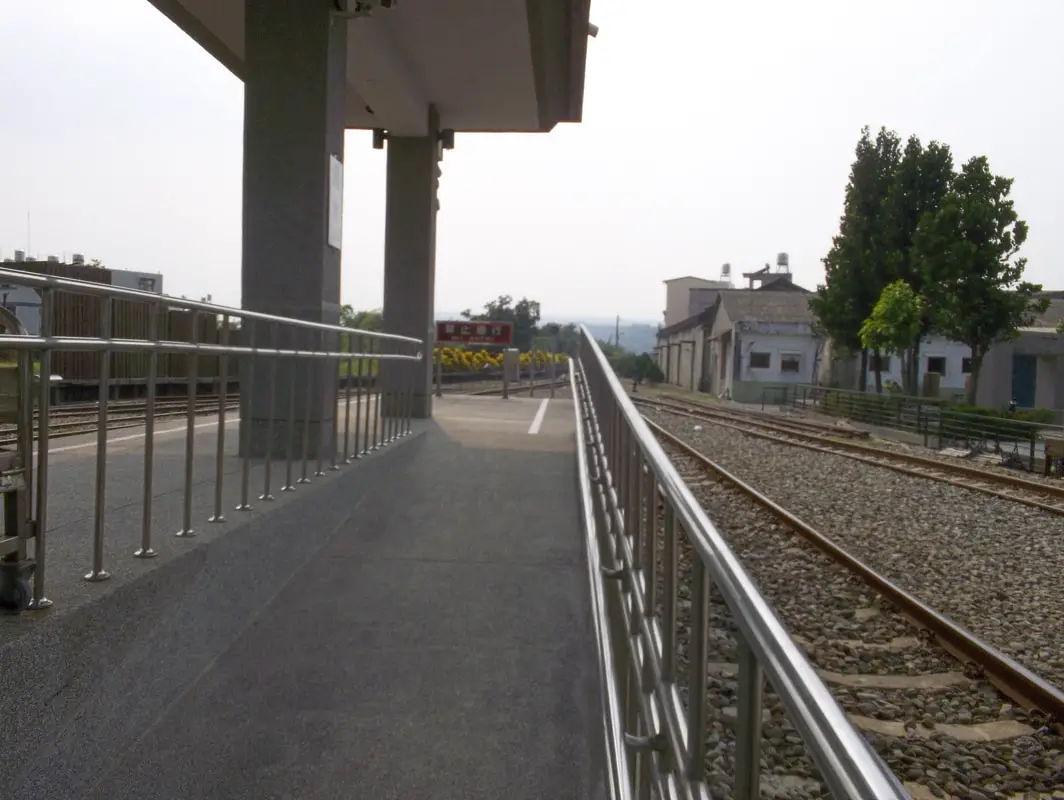
Ershui Railway Station is the first station along the Jiji Line. Located in Ershui Township, Changhua County, is a second-class Taiwan Railways station serving both the West Coast Main Line and the Jiji Line. First opened in 1905 under the name “Nihachisui” (二八水) and renamed “Ershui” in 1920, the station became an important junction when the Jiji Line began operation in 1922. The current reinforced concrete station building, designed by Japanese architect Ushi Takedake in 1933, is now a designated county-level historic site, while the nearby wooden stationmaster’s residence is listed as a historic building. Ershui was once connected to the sugar railway network, which operated from 1911 until the 1960s. The station features one island and one side platform and remains a key transfer point for travelers heading to the Jiji Line and Sun Moon Lake, with historical monuments marking its tourism role. In 2024, Ershui Station handled about 2,068 passengers per day, ranking 96th among all TRA stations, showing a stable recovery in ridership following earlier declines due to the pandemic.
Songbo Temple Trail 松柏廟步道
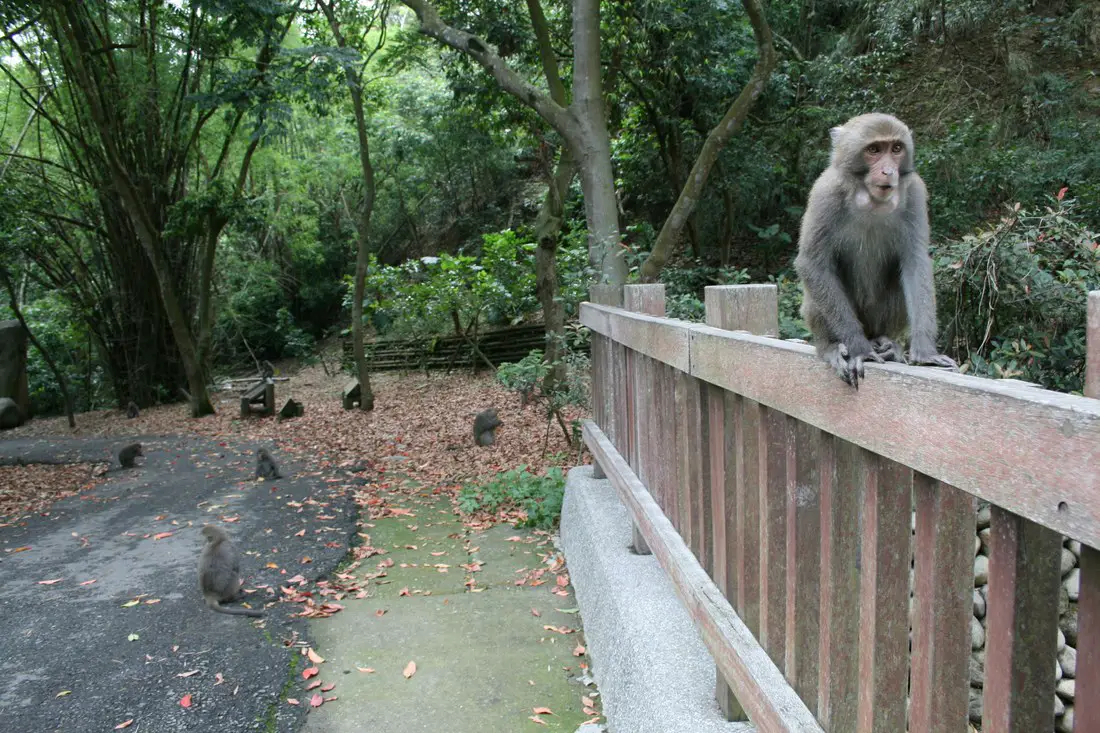
The Songbo Temple Trail runs through the forest that goes from Ershui Village in Changhua County up the mountain to Songbo Temple in Nantou County. Along this trail, one can spot lots of Formosan Macaques, which are indigenous to Taiwan. If you come, you can enjoy a sure sighting of monkeys, but for your safety, do not feed them or get close to them. Check out our full blog here.
Yuan Quan Station 源泉車站
Yuanquan Railway Station, located in Hexing Village, Ershui Township, Changhua County, is a small station on the Jiji Line operated by the Taiwan Railways Administration. Originally opened on November 18, 1910, under the name “Bizitou Station” as part of the Meiji Sugar Company’s line, it became part of the Taiwan Power Company’s Jiji Line in 1922 and was renamed “Yuanquan” in 1962. The station was downgraded to an unattended flag stop in 1979 and is now managed by Ershui Station. It has a single-sided platform and serves DR1000 diesel multiple units operating local (區間) services. In 2024, Yuanquan Station recorded an average of 78 passengers per day, ranking 212th among all TRA stations. Despite its small size, it remains one of the oldest stations on the Jiji Line and continues to serve the rural communities between Ershui and Zhuoshui.
Because there were no notable scenic sites around, I did not stop and take photos here. But be sure to explore the area and prove me wrong!
Zhuoshui Station 濁水車站

Next on the railway line is Zhuoshui Station, located in Zhuoshui Village, Mingjian Township, Nantou County. It first opened on January 14, 1922, under the name “Mingjian Station 名間車站” and was renamed “Zhuoshui Station” two months later during Japanese rule. The station was rebuilt several times, most recently in 2003 after the 921 Earthquake destroyed the previous building. It is classified as a Type C simple station, one of only two of its kind in all of Taiwan, and is the only station on the Jiji Line that handles train passing operations. The station has a single island platform and is currently managed by Ershui Station. In 2024, Zhuoshui Station served about 163 passengers per day, ranking 197th among all TRA stations. Though modest in scale, it remains operationally important for rail traffic on the scenic Jiji Line.

Zhuoshui in Mingjian is a small rural town, but there is still a lot to explore here. There is also a McDonald’s along the main road here.
Mingjian Leaning Power Line Tower 名間傾斜電線塔

East of the main road, you will notice signs of the 921 earthquake. You can see a powerline tower that is leaning, purposely left that way as a monument to the 921 earthquake.

Here is another view of the leaning powerline tower.
Longquan Station 龍泉車站

Next on the line is Longquan Station. Longquan Railway Station, located in Longquan Lane, Tianliao Village, Jiji Township, Nantou County, is a small stop on the Jiji Line operated by the Taiwan Railways Administration. The station first opened on January 14, 1922, under the name Ailiao Station, and was renamed Longquan on April 1, 1962, along with several other stations. It was downgraded to a flag stop in 1979 and is now managed by Ershui Station. The station features two side platforms and a single track arranged in a Spanish-style layout, making it the only station in Taiwan where trains open doors on both sides simultaneously. In 2015, Longquan began accepting multiple smartcards, and a new south-side platform opened in 2016. It is served by DR1000 diesel multiple-unit local trains on the Jiji Line. In 2024, Longquan Station recorded an average of 25 passengers per day, ranking 227th among all TRA stations, making it one of the least-used yet most distinctive stops on the line.

Another view outside the station. Besides service to a few local residents, it doesn’t seem like this station sees much use. And to be honest, there is not much around.

However, nearby the road passes under the cover of trees, which is quite rare in Taiwan, making it a tourist attraction.
Jiji Green Tunnel 集集綠色隧道

Here is a view of the Jiji Green Tunnel. There are many other similar green tunnels in Taiwan, such as Xinwu Green Tunnel 新屋綠色隧道, Tainan Sicao Green Tunnel 四草綠色隧道, and Taitung Longtian Green Tunnel 台東龍田綠色隧道. You can come and take photos here if you want. Usually, there are not many cars around. But be careful.

Converging lines as we rolled on to Jiji. There is a line that diverts to an army logistics center near here.
Jiji Station 集集車站

Next on the line is Jiji Station. Jiji Railway Station, located on Minsheng Road in Jiji Township, Nantou County, is a simple station on the Jiji Line operated by the Taiwan Railways Administration and managed by the Jiji Township Office. It first opened on January 15, 1922, under the Japanese name Shushu Station, and the current wooden building was rebuilt in 1930 using materials relocated from the old Yangmei Station on the West Coast Line. Once downgraded to an unattended stop, it regained simple station status in 1996, when the township office began managing and selling tickets. Severely damaged during the 921 Earthquake in 1999, the historic wooden station was restored to its original form and reopened in 2001, now serving as both a railway stop and a tourist landmark featuring the Jiji Railway Museum and classic name-card-style paper tickets unique to this station. It has one island platform and is served by DR1000 diesel multiple-unit local trains. Jiji Station is one of the most visited stops on the Jiji Line and is listed among Taiwan’s Top 100 Historical Buildings. In 2024, it handled an average of 238 passengers per day, ranking 190th among all TRA stations.
Jiji Old Street 集集老街

I have been to Jiji twice. It may be the busiest place on the line. You might call it an old Street. There are lots of shops and some pieces of military hardware.
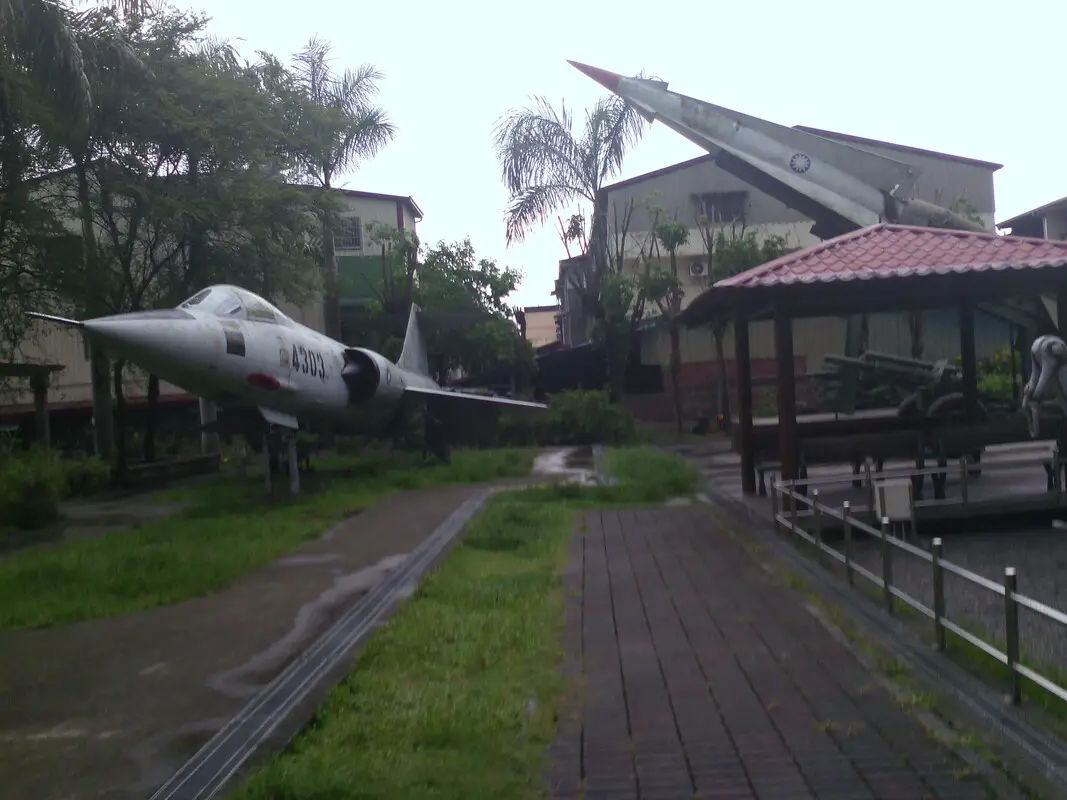
Retired fighter jet, rocket, and towed howitzer. I think there is a military base somewhere nearby.

Some shops and a pedestrian walkway. Jiji is also a popular cycling destination.
Also, there are lots of scooter rental shops around. One time, I rented a scooter here with no international license during a day with torrential rain. We rode through the mountains of Guoxing to get from Caotun back to Jiji Station. It was basically like riding jet skis through the mountains. It was one of the most fun scooter rides I have ever been on.
Jiji Wuchang Temple 集集武昌宮

The Jiji Wuchang Temple (aka 921 Earthquake Museum 九二一地震紀念館) in Jiji Township of Nantou County is a monument to the 921 earthquake that hit Taiwan in 1999, which killed thousands of people. The temple stood near the epicenter of the earthquake, and the first floor of the temple collapsed. Now, a new temple has been built, but the old one has been left untouched, a testament to the power of the 921 earthquake. Check out our full blog here.

The inside of the old Wuchang Temple looks the same as the day of the earthquake.

There is also a market right next to the temple here.

View of the mountains from the parking lot here.

The newly rebuilt Jiji Wuchang Temple, which sits in front of the old one.

Another street in Jiji.

More shops and a pedestrian area in Jiji.

Busy road in Jiji.

Another street between Jiji and Shuili.
Shuili Station 水里車站

Next on the line is Shuili Station. Shuili Railway Station, located on Minsheng Road in Shuili Township, Nantou County, is a simple station on the Jiji Line operated by the Taiwan Railways Administration. It first opened on January 14, 1922, under the name Shuilikeng Station, and later changed names several times before adopting its current name in 1967. The current station building was completed in 1970, and although it was once a staffed third-class station, it was downgraded to a simple station in 1989 and is now managed by Ershui Station. Shuili is the largest station on the Jiji Line and serves as the main gateway for the township, featuring one island platform, though only the outer (B-side) is currently in use. The station offers commemorative railway stamps and sells tickets through automated systems introduced in 2015. Trains serving the station are DR1000 diesel multiple-unit local trains. In 2024, Shuili Station recorded an average of 172 passengers per day, ranking 195th among all TRA stations, reflecting its role as a modest yet regionally important stop on the scenic Jiji Line.

View from the front of Shuili Station.

View looking at Shuili Station. It is the biggest station in terms of building size on the Jiji Railway line.

View looking down Minsheng Road in Shuili.

View of a market down Minzu Road.

Tea shops and more are near the riverside.

Riverside near Shuili.

Another view of the riverside.

View down the Zhuoshui River, the longest river in Taiwan.

And we continue onward.
Checheng Station 車程車站

Checheng is the last stop along the Jiji Railway Line in Nantou, and includes a large old street and shopping area, including restored historical Japanese buildings, hearkening back to the historical importance of the town as a logging hub. Here you can find museums, snacks, and beautiful scenery. It is definitely worth a stop. Check out our full blog on Checheng here.
Checheng Railway Station, located in Shuili Township, Nantou County, is the terminal station of the Jiji Line and is named after the Taiwanese word “埕,” meaning “yard,” referring to the many sugar carts once parked there when the Puli Sugar Factory began transporting sugar in 1916. Established in 1922 as “Outer Checheng Station” and renamed in 1955, it has experienced several changes, including damage from the 1999 earthquake and rebuilding in 2001. Managed by the Shuili Township Office, it remains one of the few stations still selling old-style card tickets. Although service has been suspended since 2021 due to tunnel damage and landslides, reopening in December 2025, Checheng Station continues to attract visitors for its railway heritage, preserved locomotives, and historic cars, while future plans include a possible cable car link to Sun Moon Lake.
Checheng Logging Exhibit 車程木業展示館

Checheng also has quite a few historical trains and a logging exhibit, showing how old logs were shipped from the mountains and transported onto trains here.
Checheng Old Street 車程老街

Checheng Old Street is a winding road up the old village of Checheng, with many shops and hostels along the way. Don’t forget to go check it out when you visit Checheng.
Mingtan Reservoir 明潭水庫

Mingtan Reservoir, also called the Shuili Dam or Mingtan Lower Pool Dam, is located in Checheng Village, Shuili Township, Nantou County, near Provincial Highway 131 and the terminal of the Jiji Railway Line. Built by Taipower between 1987 and 1995 at a cost of NT$50.8 billion, it serves as the lower reservoir for the Mingtan Pumped Storage Hydroelectric Plant—one of Taiwan’s 14 major construction projects. Constructed as a 61.5-meter-high concrete gravity dam on the Shuili River, the reservoir has a total capacity of 14.4 million cubic meters and works together with Sun Moon Lake, which serves as the upper reservoir. During off-peak hours, surplus power from nuclear and thermal plants pumps water from Mingtan Reservoir up to Sun Moon Lake; during peak hours, the stored water is released downward through six reversible Francis turbines and generators, each producing 267 MW, for a total capacity of 1,602 MW and an annual output of about 2.4 billion kWh—making it Taiwan’s largest hydroelectric facility. Much of the plant’s structure, including its massive underground power cavern, lies deep inside the mountain, and the 380-meter elevation difference between the two lakes creates efficient energy cycling, with Mingtan’s water level fluctuating up to 28 meters daily, giving the reservoir a unique “tidal” appearance.

Last view of the Mingtan Reservoir.
And that concludes our guide to the Jiji Railway line. This blog was in no way comprehensive, and there are many more sights to explore along the way. Go discover them for yourself!
There are many tours and activities available in Nantou, such as river Tracing, paragliding, Shanlinxi Forest Recreation Area 杉林溪, Cona’s Chocolate Castle, Shuiyuan Suspension Bridge, JOJOZOO Park, and Aowanda Forest Recreation Area.
You can find more tours of Nantou on Klook here or KKday here.
Check out our full guide to Nantou County here.
Check out our guide to Taiwan here.